
24
Jun
Emergency Department vs OP Visit: Where Should You Go First?
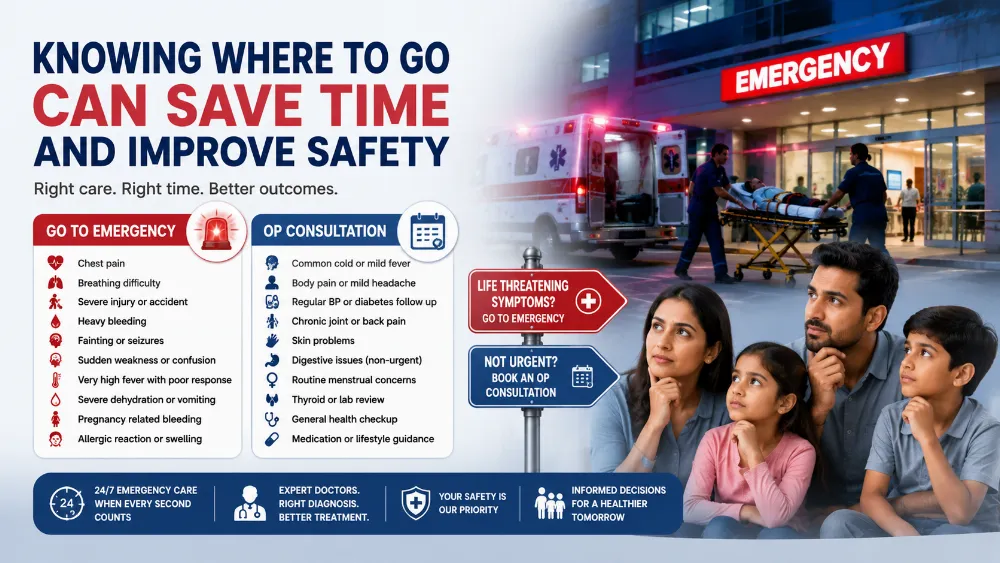
Knowing where to go can save time and improve safety
When someone feels unwell, families often struggle with one basic question: should we go to the emergency department or book a regular outpatient visit? The answer depends on the severity, speed, and type of symptoms. Choosing the right point of care helps patients get faster treatment and avoids dangerous delay. In Mattannur, Kannur, Kuthuparamba, Irikkur, and Kasaragod, many patients arrive late in emergencies because they hoped the problem would settle. Others visit emergency care for mild problems that could have been handled in OP. A simple understanding of red flag symptoms can help families make better decisions.
When the emergency department is the right choice
Go to an emergency department for chest pain, breathing difficulty, severe injury, heavy bleeding, fainting, seizures, sudden weakness, sudden confusion, severe dehydration, very high fever with poor response, pregnancy related bleeding, severe abdominal pain, or any condition where the patient looks rapidly worse. Emergency care is also important after road accidents, deep cuts, fractures, poisoning, and allergic reactions with swelling or difficulty breathing. In children and elderly adults, warning signs can be less obvious, so low energy, altered behavior, and poor intake should also be taken seriously. Emergency care exists for conditions where every minute matters.
What can wait for an OP consultation
Common cold, mild body pain, regular diabetes follow up, stable blood pressure review, routine menstrual questions, chronic joint pain without sudden swelling, mild skin issues, and non urgent digestive symptoms usually fit better in an OP visit. OP care allows a more scheduled, focused consultation and is ideal for problems that are important but not immediately dangerous. Patients also benefit from planned follow up and specialist selection in OP settings. However, if a mild symptom suddenly worsens or begins to affect breathing, consciousness, hydration, or severe pain levels, the situation changes and emergency assessment may be more appropriate.
Why delay can be risky
One of the biggest dangers in health care is delay. Families sometimes wait because of fear, confusion, or the assumption that pain will settle. A heart attack, stroke, severe infection, or breathing problem may become much harder to treat if the patient reaches care too late. It is better to rule out a serious problem early than to take chances with dangerous symptoms. The same applies to children who stop feeding, elderly adults who become suddenly weak, and pregnant women who develop bleeding or severe headache. Fast action matters more than perfect certainty.
Questions families can ask quickly
If you are unsure, ask a few simple questions. Is the symptom sudden and severe? Is breathing affected? Is the patient able to walk, speak, drink, and stay alert? Is there major pain, bleeding, or repeated vomiting? Is the patient very young, elderly, pregnant, diabetic, or already medically fragile? If the answer raises concern, do not delay emergency evaluation. These quick checks help turn confusion into action and reduce the chance of dangerous waiting.
Good care begins with good judgment
Emergency medicine and regular OP care both have an important place. The key is using them correctly. Patients and families who understand warning signs often get better outcomes because they reach the right care earlier. If in doubt, it is safer to seek urgent medical evaluation for significant symptoms than to continue home observation for too long.

